Edge Synchronizer Client
Selling in a physical store is critical, and internet disruptions can be costly. Edge computing addresses this by enabling local data processing and failover.
The Hii Retail Edge Synchronizer client is a library for synchronizing master data entities between the cloud and in-store systems. It can run on a server, POS, or any capable in-store computer, or as part of a dedicated Edge Computing solution.
The client synchronizes with the cloud, transferring delta changes in near real-time. Data is stored locally and events are triggered for custom handling, supporting offline and failover scenarios.
Stores can use local or cloud endpoints as primary, with failover as needed.
Example: Existing Transformation Service
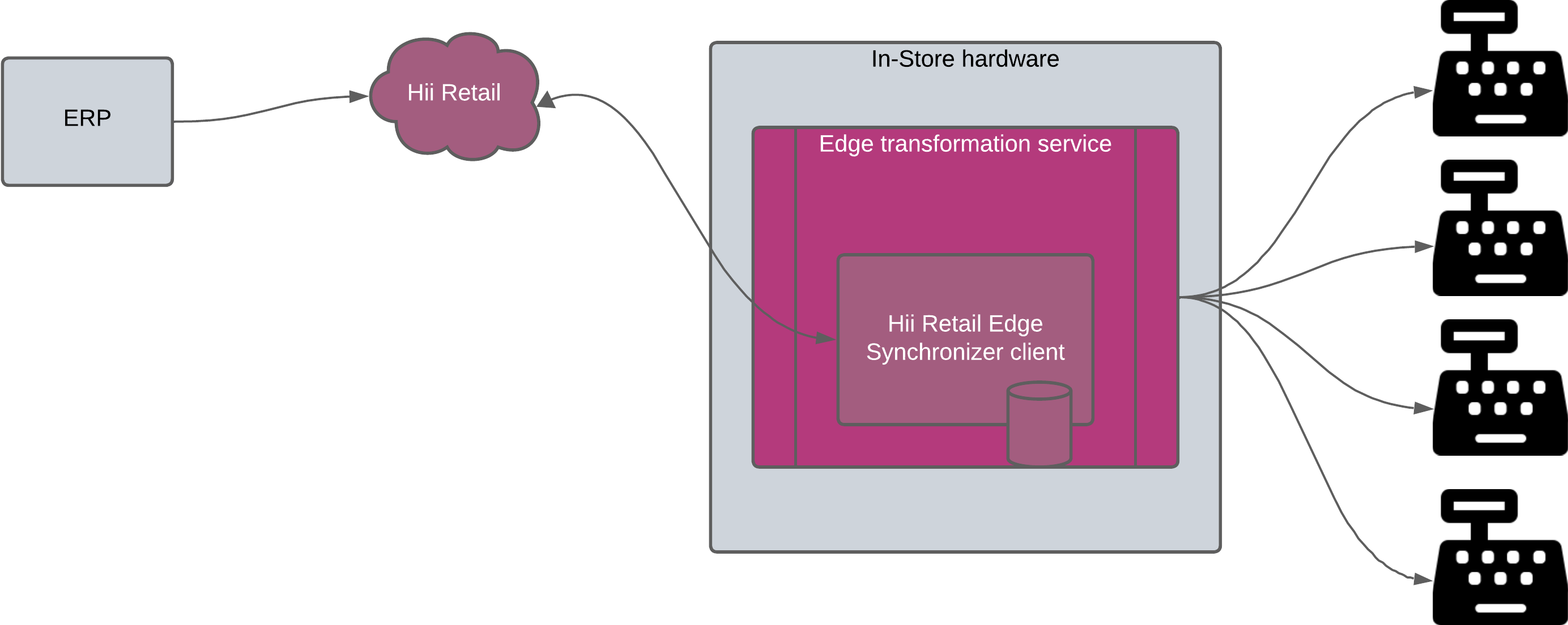
The Edge Synchronizer Client can be embedded in a new or existing edge transformation service. It synchronizes with Hii Retail Cloud, saving data locally and emitting events for further processing.
The transformation service must convert data to the required local format and maintain relationships or validations for legacy systems.
Example: Avassa Edge Computing
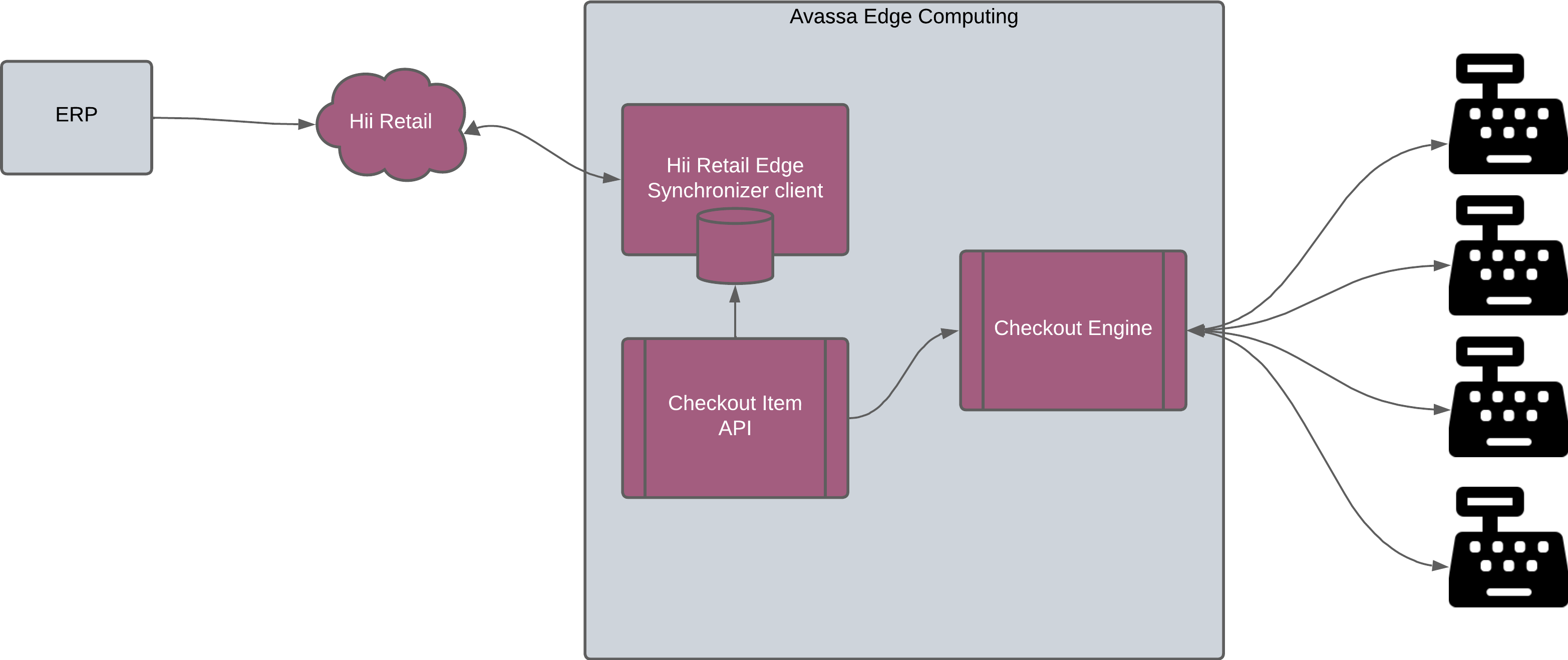
Avassa provides Edge Computing devices for Extenda Retail. Edge devices can be managed and updated from Hii Retail Cloud, allowing stores to failover between local and cloud endpoints as needed.
Why stores run this at the edge
A store cannot pause selling because its internet connection drops. Checkout — scanning items, pricing them, ringing up a sale — has to keep working whether or not the store can currently reach Hii Retail Cloud. The Edge Synchronizer Client is what makes that possible for checkout: it keeps a continuously up-to-date, local copy of item and pricing data in the store itself, so the checkout experience doesn't depend on a live connection to function.
The reference implementation of this is the Checkout Item solution, built from the Edge Synchronizer Client and validated on Avassa edge devices:
- Item and category data is kept in sync locally, in near real time, whenever the store is online.
- If connectivity is lost, checkout keeps reading from the local copy — customers are unaffected and staff don't need to intervene.
- Once the connection returns, the synchronizer catches back up automatically; no manual reconciliation is required.
- Each store's edge deployment only ever holds its own tenant's and business unit's data, so an outage or misconfiguration at one store has no bearing on another.
This is what allows retailers to treat store connectivity as a resilience concern rather than a checkout-availability concern: the failure mode of "the internet is down" degrades gracefully instead of stopping sales. It complements the platform's Business Continuity and Disaster Recovery posture on the cloud side, extending the same continuity guarantee out to the store.