Cash Management
Cash Management answers one question for every store: how much cash is in the safe? It keeps the safe's balance in each currency, and changes it every time cash goes in or out: the morning float leaves for the tills, the counted cash comes back after closing, a bag goes to the bank. Once a day the store manager counts the safe in a safe audit, and Cash Management books any difference and sends the extra cash to the bank.
Every movement is published as an event, so an ERP or accounting system can keep its own record of the store's cash.
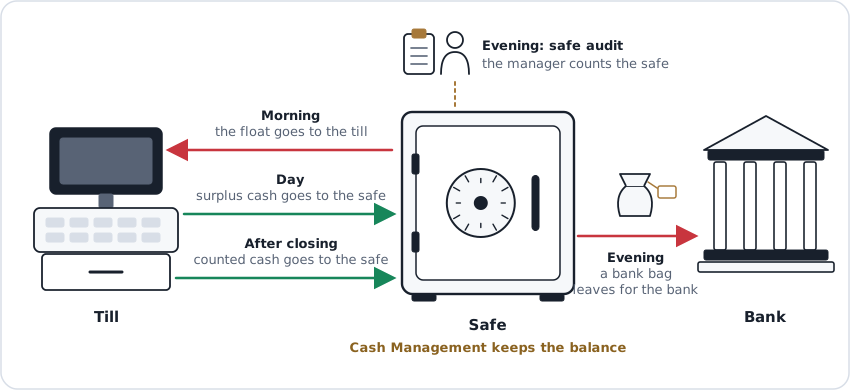
Cash Management works together with Reconciliation. Reconciliation follows the cash in the drawers and reports every amount that moves between a drawer and the safe. Cash Management follows the cash in the safe, and books what Reconciliation reports. Neither has to be told twice.

What it handles
| In the store | What Cash Management does |
|---|---|
| A till opens with a float from the safe | takes the float out of the safe |
| Cash is brought from the safe into a drawer, or taken from a drawer to the safe, during the day | moves the amount out of or into the safe |
| A till audit is completed after closing | puts the counted cash into the safe |
| A till audit is recounted | puts the correction into, or takes it out of, the safe |
| Cash is fetched from the bank | puts it into the safe |
| A bank bag leaves for the bank | takes it out of the safe |
| The manager counts the safe | books the difference from the expected balance as a correction |
| The manager closes the day with a safe audit | books the difference, the bank drop and any customer-defined amounts, and publishes the audit |
The first four rows come from Reconciliation, and are described in Cash to and from the safe. The rest are actions of the store staff, described on these pages.
Who works with the safe
The work happens in the store, by the store manager or the staff trusted with the safe. They record bank deposits and withdrawals, count the safe, and close the day with a safe audit. They do it in the Cash Management module of Hii InStore, the back-office application Extenda supplies, so you do not need to build a client for it.
Every action in Hii InStore is an ordinary call to the Cash Management API. If you want to drive these
actions from your own system, these are the calls involved. Each path starts with
/api/v1/business-units/{businessUnitId}, or /api/v2/business-units/{businessUnitId} where marked v2:
| In Hii InStore | API call |
|---|---|
| From Bank: cash fetched from the bank | POST …/repositories/{repositoryId}:bank-withdrawal |
| To Bank: a bank bag sent to the bank | POST …/repositories/{repositoryId}:bank-deposit |
| Count Safe: book the counted cash | POST …/repositories/{repositoryId}:corrections |
| Safe Audit: see what to count | GET …/repositories/{repositoryId}/audits/audit (v2) |
| Safe Audit: submit it | POST …/repositories/{repositoryId}/audits (v2) |
| Safe Audit History | POST …/repositories/audits:search |
| Latest Transactions | POST …/repositories/transactions:search |
An integrator normally needs none of these calls. The tills' cash reaches the safe through Reconciliation, and your systems receive every movement through External Events. You subscribe to what comes out. You do not take part in the counting.
If you want to…
| …then read |
|---|
| know what moves the safe's balance, and what does not |
| set up the safe for a store before it starts trading |
| understand bank deposits, withdrawals and corrections, and when a reason code is needed |
| understand the daily safe audit: what is counted, what is booked, and when cash must go to the bank |
| see everything Cash Management needs from other services |
| configure limits, the safe audit and customer-defined fields |
| call the API |
| receive the safe's movements and safe audits in your own system |
Terminology
| Term | Meaning |
|---|---|
| Safe | The store's safe or vault. In the API it is a repository of type Safe, identified by repositoryId. |
| Repository | Somewhere Cash Management keeps a balance: the store's safe, or a cash changer. |
| Balance | The cash a repository holds in one currency, according to the movements booked. |
| Transaction | One movement of one currency into or out of a repository. Each published event holds one or more. |
| Event type | What kind of movement a transaction is, such as BankDeposit or Reconciliation. |
| Till audit | One cash drawer's count in Reconciliation. Its counted cash goes into the safe. |
| Float | The cash a drawer starts the day with. Also called the initial balance. |
| Tender loan | Cash brought from the safe into a drawer during the day. |
| Tender deposit | Cash taken from a drawer to the safe during the day. Also called a pickup. |
| Bank deposit | Cash sent from the safe to the bank, in a bank bag. In Hii InStore: To Bank, or the Bank drop in a safe audit. |
| Bank withdrawal | Cash fetched from the bank into the safe. In Hii InStore: From Bank. |
| Bag reference | The number on a bank bag, carried as referenceId. |
| Correction | A change to the safe's balance that makes it agree with what was counted. |
| Safe audit | The daily check of the safe: the cash from the till audits, the rest of the safe counted by hand, the difference, and the bank drop. |
| Cash changer | A cash-handling device, such as a cash recycler, counted by Reconciliation as its own till audit. |
| Business date | The trading day a movement belongs to, which can differ from the calendar date for stores open past midnight. |