Architecture
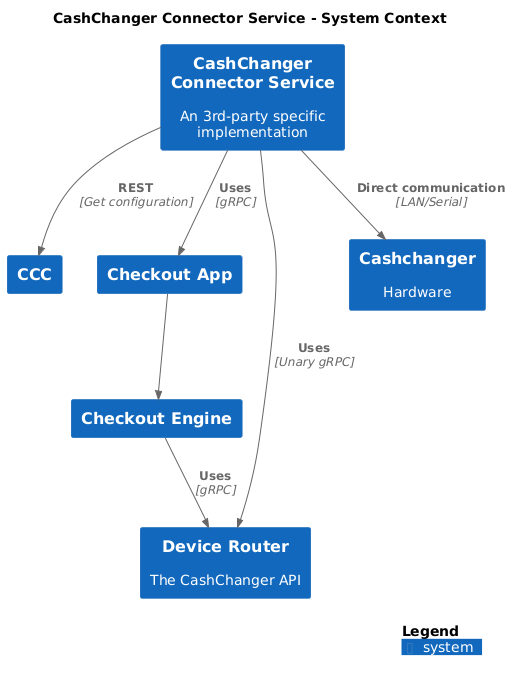
System context
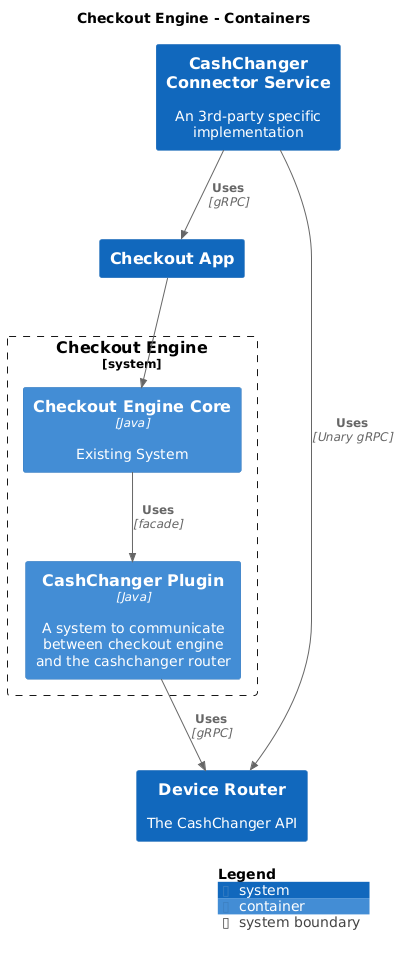
Containers
Architecture decision records
- ADR-0001 - Record architecture decisions
- ADR-0002 - gRPC
- ADR-0003 - Use Java 21 Loom for multithreading
- ADR-0004 - Follow API-First practices
- ADR-0005 - Use Cloud Run
- ADR-0006 - Use CCC Configuration Portal for customer configuration
- ADR-0007 - Use bidirectional event streams with the Checkout App
- ADR-0008 - Use Service Manager
- ADR-0009 - Use Device Router
APIs
The following APIs are part of cashchangers:
TO BE CREATED
IDEALS
Hii Retail services adheres to the IDEALS principles in microservice architecture. This section covers how the design choices in cashchangers fulfills the IDEALS.
Interface segregation
The API for sending requests is a proto3 interface.
The API for receiving responses is a proto3 interface.
Deployability
We will deploy in three environments: cloud, edge and local. For deployment, we will use:
- for the cloud: Cloud Run.
- for the edge: Avassa.
- for local: Service-Manager.
The services in the solution are designed to be independently releasable and uses schema-based communication internally via gRPC.
Event-driven
All services are designed as being event-driven, where requests and/or events trigger flows that eventually triggers RPC-calls. The services require no CPU cycles outside the request context -- save the maintenance of keeping streams up.
Consistency over availability
The system is designed to be an extension to the hardware in store. The actual hardware maintains state, as well as the in-store application.
Loose-coupling
This set of services does not rely on any other than the Checkout Engine, as a consumer of our APIs.
Single responsibility
Each of the services within the suite is purposefully built to fulfill its requirement;
- Connector processes requests and models responses of the data received from the stores and acts as a message broker for the request/response and events flowing between the cloud and stores.
Multi-tenancy
The suite of services is fully multi-tenant.
Auditing
There is no current need to implement auditing.
Security
- All ingress and egress uses TLS
- All APIs are secured using either
- Hii Retail IAM (for users)
- Workload identity
- OCMS
Redis is namespaced by service, so that each service has its own queues/maps.
Each response in the outbox prefixes each entry by tenant-id in addition to namespace.
Legal compliance
The service will not use any directly identifying personal data.
Data mesh
Not in scope.
Global reach
Redis is a component we have that we cannot scale beyond regions.
Internationalization
Responses and events will need translation support. When the implementation is needed we will investigate the most appropriate approach, also taking into consideration any possible translation service.